My customers have not asked to shop through an AI agent. Why should I offer one?
AllHub Team··6 min read
Most customers did not ask to shop on mobile, receive personalised recommendations or resolve a question through WhatsApp either. What they wanted was simpler: to find what they needed sooner, understand the differences between products and buy without wasting time.
AI agents follow the same pattern. A shopper is unlikely to enter a store saying, “I want to use an artificial intelligence agent.” They will usually describe a need instead: “I need a lamp for a small terrace,” “Which rug would suit a traditional living room?” or “I need a gift for under €50.”
One point should be clear from the beginning: customers do not buy inside the AllHub agent. The Conversational Storefront Agent helps them find, compare and collect products in a wishlist. Once their selection is ready, it takes them to the store’s own checkout.
AI-generated content
The agent helps shoppers discover and select products; the purchase is completed in the store’s own checkout.
Your customers do not ask for tools: they ask for results
Shoppers rarely request features using the language of a technology company. They do not ask for an advanced search engine; they want to find a jacket in their size. They do not request a recommendation system; they want to discover which product suits their needs and budget.
The useful question, therefore, is not only whether anyone has requested this technology. You should also examine whether customers can easily find the right products or abandon the store because searching, comparing and deciding requires too much effort.
What signals show that they need more help?
They use broad searches that return too many results.
They open numerous product pages before deciding.
They repeatedly ask about sizes, materials, uses or compatibility.
They arrive from social media without knowing how the catalogue is organised.
Suitable products receive few visits because they are difficult to find.
When these situations repeat, there is a product-discovery problem. That is where the ability to find products with an AI agent can provide value.
With AllHub, the agent does not buy on the customer’s behalf
Some distrust comes from treating very different systems as if they were the same. Certain autonomous agents may try to choose a product, complete customer details and execute a transaction. That model raises questions about authorisation, spending limits, mistakes, payments and liability.
AllHub has a different scope. It does not buy on the customer’s behalf. The AI agent for ecommerce supports discovery and selection but does not make an autonomous purchase. The shopper remains in control of the decision from beginning to end.
What does the real customer journey look like?
The customer explains what they need in their own words.
The agent consults the catalogue connected to the store.
It presents relevant products and helps compare them.
The shopper adds suitable options to a wishlist.
When finished, the shopper continues to the store’s own checkout.
AllHub reduces the work involved in searching and comparing, but the purchase always continues in the store.
Helping someone decide is not deciding for them
A shopper may distrust a system that selects and pays without their involvement while valuing a tool that saves them from reviewing one hundred products to find three sensible options. These are two different experiences.
The conversational storefront lets people explain a need, add criteria, resolve questions and understand differences. They still decide which products to save, which to discard and when to leave the conversation or continue to the store.
AllHub assists during selection; it does not replace the shopper’s approval.
Why offer something customers have not asked for yet?
Because a need can exist even when the user does not know the name of the solution. Customers cannot always explain why a store feels difficult to use. They simply fail to find what they want, grow tired of comparing or leave.
Not asking for it does not mean not needing it
The lack of a request may mean that customers do not know the option exists, have accepted an inconvenient experience as normal or leave before contacting the store. They may also be resolving the question on Google, on social media or with another merchant.
A conversational shopping experience gives people who do not know where to begin another route. It does not force customers who prefer search, categories or traditional filters to change the way they browse.
AllHub helps customers choose; your store makes the sale
The division of responsibility is straightforward. AllHub understands the need, checks the connected information, shows products, helps compare them and prepares the wishlist. From that point, the customer moves to the store.
What does the merchant continue to control?
Checkout and customer identification.
Payment, taxes, discounts and shipping costs.
Order confirmation and preparation.
Shipping and tracking communications.
Exchanges, returns and after-sales service.
AllHub does not touch the money, process the payment or become the seller. The transaction and the commercial relationship remain with the ecommerce business.
The agent prepares the selection; checkout, payment and the order belong to the store.
The agent does not replace a store that already works
Different shoppers may prefer different journeys. Someone who knows exactly what they want will use search. Someone familiar with the catalogue will browse categories. Someone who needs guidance can begin a conversation.
An additional option, not an obligation
Access can be offered through a dedicated page, a button or a widget. Its URL can also be shared through WhatsApp, email, Instagram, TikTok, Facebook, X or a QR code. Customers decide whether to use it and can return to the traditional store whenever they wish.
The AI shopping assistant should be introduced clearly: it helps people find products and uses information supplied by the merchant. It should not pretend to be a person or promise actions it cannot perform.
How can you tell whether customers actually need it?
You do not need to assume that customers need it. Test it with a specific category, especially one containing many products, variants or questions that shoppers ask before choosing.
What should you observe during the test?
How many people open the experience and start a useful conversation.
What needs they describe and which products they receive in response.
Which products they save to their wishlist.
How many shoppers continue to the store.
Which questions remain unanswered and which searches find no product.
These signals show whether AI product recommendations are reducing a real difficulty. They also reveal missing attributes, recurring questions and needs that the current catalogue does not cover.
The agent is only as useful as the store information it receives
Artificial intelligence cannot magically repair an incomplete catalogue. To recommend responsibly, it needs clear names, accurate descriptions, relevant attributes, properly connected variants, and current prices and stock levels.
What happens when information is missing?
AllHub consults the data connected to the merchant. If a feature, policy or availability detail is not documented, the agent should not invent it. The test also reveals which information the store needs to improve.
The right question is not whether customers asked for an agent
The right question is whether you provide enough help to people who intend to buy but do not yet know which product to choose. If the catalogue is already small, clear and easy to browse, the effect may be limited. If finding and comparing takes too much work, it is worth testing.
What are you actually offering?
You are not offering a machine that buys for the customer. You are offering a more direct way to move from a need expressed in ordinary language to a list of suitable products.
The shopper then enters your checkout, confirms the selection and completes the transaction with you. Your store collects the payment, manages the order and keeps the commercial relationship.
Your customers may never ask you for an AI agent. Yet every failed search and unanswered question may be their way of asking for an easier way to find the right product.
We build the AI agent team that sells, supports and grows ecommerce stores — EU-hosted, GDPR-first.
This article was created with the help of AI and reviewed by our team. We take great care over every post and every translation, but the odd mistake can still slip through. If you find one, write to us: you will be helping us improve.
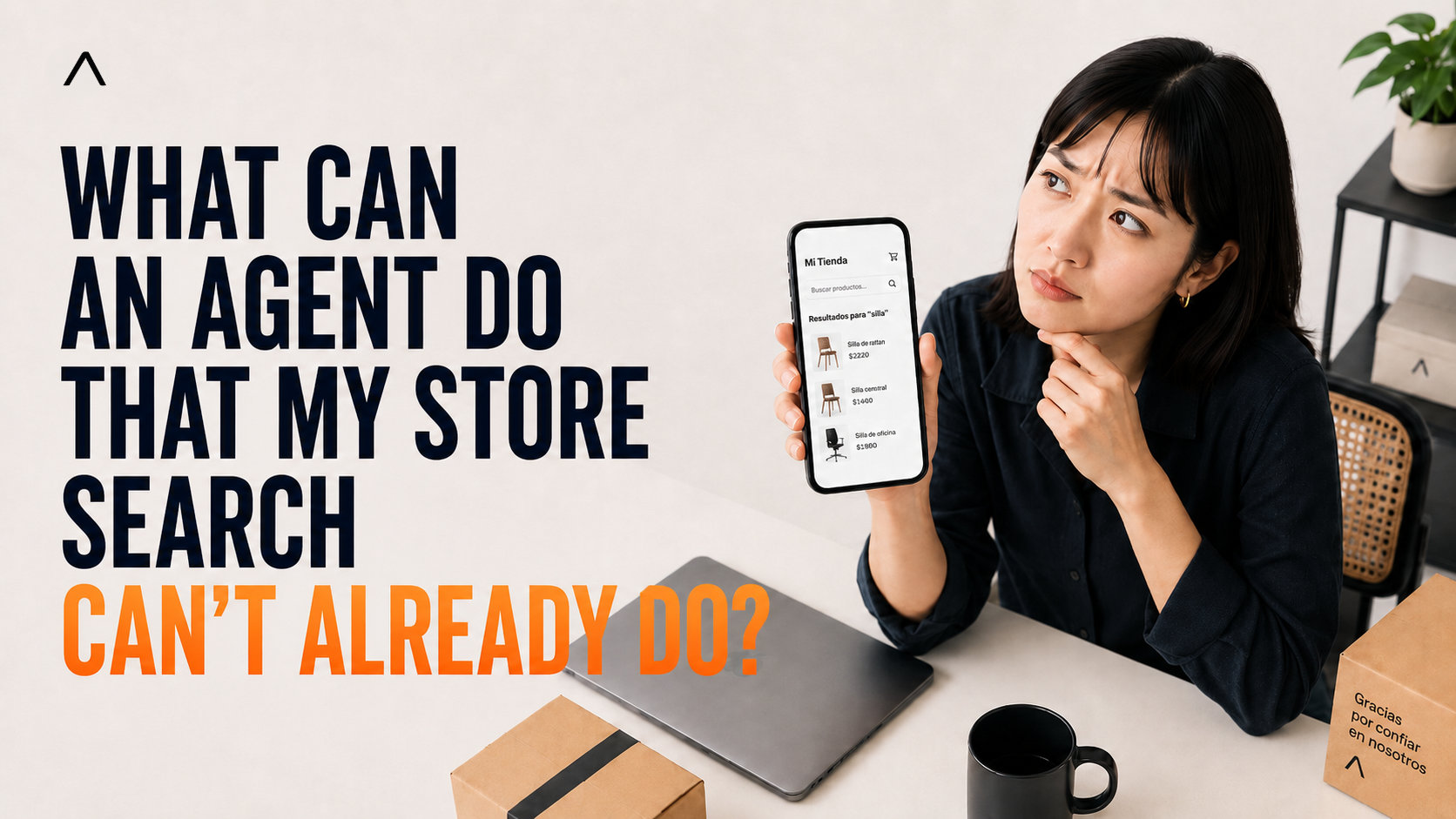
Search finds products when a shopper knows what to type. An agent helps when they know the outcome they need but cannot yet turn it into a useful query.


 AI-generated content