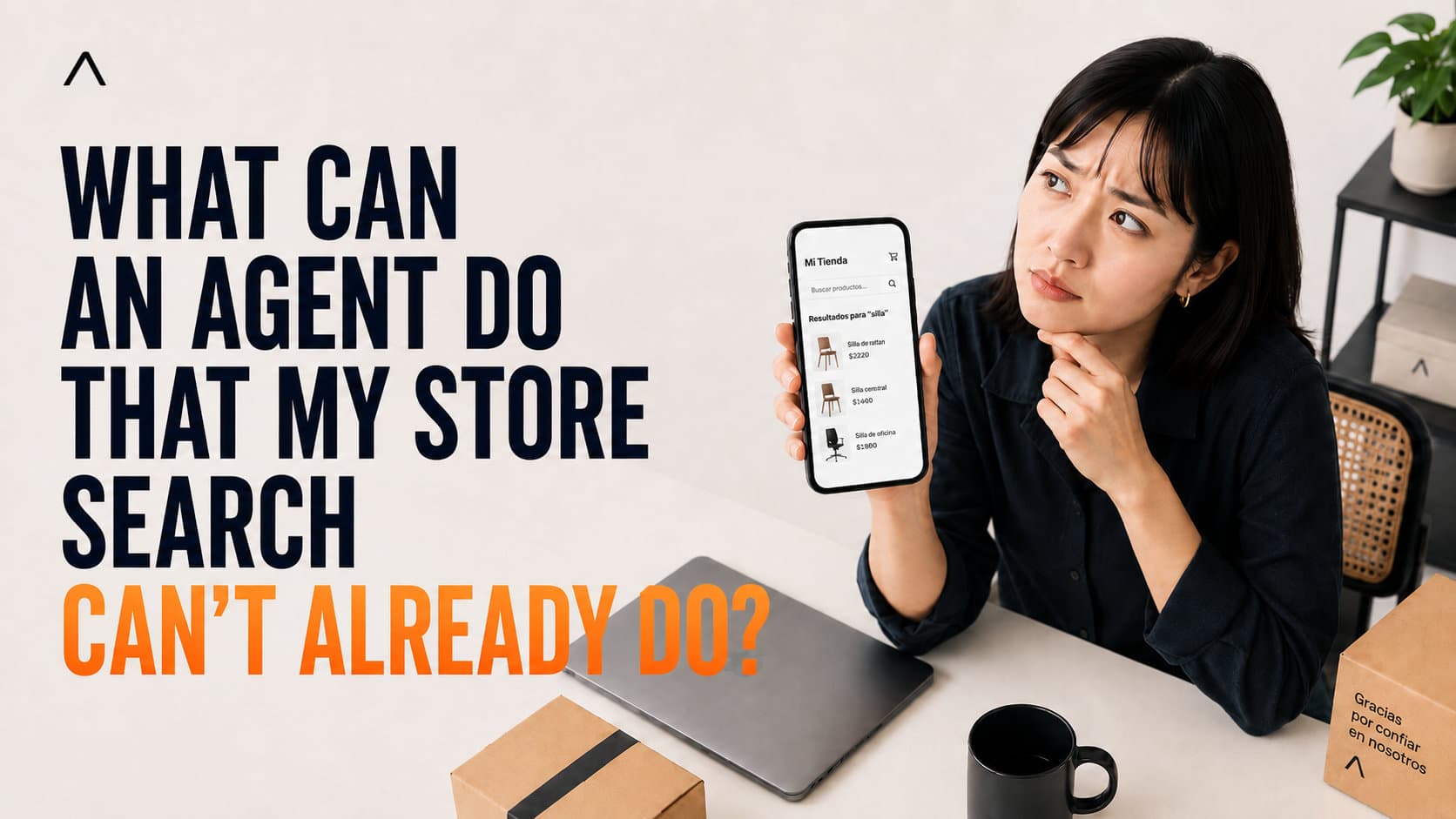
What can an agent do that my store search cannot already do?
AllHub Team··6 min read
Your store search is not obsolete. When somebody enters an exact reference, brand or product name, it is probably still the fastest route to the result.
The difference appears before that query. Many shoppers know what they want to achieve but not your taxonomy, the attribute that matters or the words that describe several constraints at once. Search receives terms; an agent can turn a need into catalogue criteria.
The useful comparison does not pit two substitutes against each other. It asks where each works best and what evidence would prove the value of an AI agent vs online store search.
AI-generated content
Search resolves known queries; an agent helps build the query when the need has no name yet.
What does your store search do particularly well?
Good search retrieves matches quickly. It excels when the shopper knows a SKU, brand, model or precise category. It should not add questions when intent is already structured.
When is a search box exactly what the shopper needs?
Good search retrieves matches quickly. It excels when the shopper knows a SKU, brand, model or precise category. It should not add questions when intent is already structured. “Nike Pegasus 41 women size 6” already contains product, audience and size. Conversation would slow down a direct route.
Why does adding an agent not mean search has failed?
Good search retrieves matches quickly. It excels when the shopper knows a SKU, brand, model or precise category. It should not add questions when intent is already structured. The interfaces receive different states of intent: defined terms versus an ambiguous need. Keeping both protects speed and choice.
The right interface depends on how prepared the intent is.
Where does search stop even when it works correctly?
Most search engines match text against names, descriptions, attributes and synonyms. Even semantic search normally expects a completed query and may not know which missing fact would narrow the results.
What happens when the customer knows the need but not the word?
Most search engines match text against names, descriptions, attributes and synonyms. Even semantic search normally expects a completed query and may not know which missing fact would narrow the results. “A chair for eight-hour workdays in a small flat that does not look like office furniture” contains use, duration, space and style but no category. See how guided discovery works with the Conversational Storefront Agent.
What does your store learn from a zero-results search?
Most search engines match text against names, descriptions, attributes and synonyms. Even semantic search normally expects a completed query and may not know which missing fact would narrow the results. A log may preserve the words, but zero results can mean a missing synonym, attribute, product or policy. Those causes need different fixes.
What can an agent interpret that one isolated query cannot explain?
An agent can retain context across turns. Usage, budget, space, compatibility and exclusions can progressively refine one selection without forcing the shopper to rewrite everything.
How does the agent decide which question to ask next?
An agent can retain context across turns. Usage, budget, space, compatibility and exclusions can progressively refine one selection without forcing the shopper to rewrite everything. The best question removes irrelevant options without collecting unnecessary data. It may ask about compatibility, size, use, budget or deadline.
How does it turn everyday language into catalogue criteria?
An agent can retain context across turns. Usage, budget, space, compatibility and exclusions can progressively refine one selection without forcing the shopper to rewrite everything. It separates requirements from preferences and checks every criterion against connected attributes. That answers what an AI agent can do that store search cannot.
Conversation turns scattered context into verifiable criteria.
Can an agent compare without deciding for the shopper?
A bounded agent can organise documented differences, explain which option meets each condition and disclose missing information without choosing on the customer’s behalf.
What changes when a result includes an explanation?
A bounded agent can organise documented differences, explain which option meets each condition and disclose missing information without choosing on the customer’s behalf. A grid displays options; an explanation connects option and need, making the recommendation reviewable rather than opaque.
What must it never invent if trust is to survive?
A bounded agent can organise documented differences, explain which option meets each condition and disclose missing information without choosing on the customer’s behalf. It must never invent compatibility, availability, materials, delivery dates or policies. Missing data must remain visibly missing.
How can search and an agent work together without duplication?
Keep two entrances to one catalogue. Shoppers with a known term use search; shoppers who need to explain context use conversation. Both routes end on the same products and checkout.
When should the agent return the shopper to search or a product page?
Keep two entrances to one catalogue. Shoppers with a known term use search; shoppers who need to explain context use conversation. Both routes end on the same products and checkout. As soon as intent is clear. The agent does not need to prolong dialogue to justify itself; it can show the item, compare two options or acknowledge a limit.
Why should nobody be forced to have a conversation?
Keep two entrances to one catalogue. Shoppers with a known term use search; shoppers who need to explain context use conversation. Both routes end on the same products and checkout. Conversation is an interface, not a commercial requirement. Navigation, filters and search remain available to everybody.
Two ways to express intent, one catalogue and one store to buy from.
What can your store learn from conversations that search does not record?
Search logs show terms; conversations can reveal the reasoning missing between need and product. Repeated questions expose absent attributes, unfamiliar naming and difficult comparisons.
How does a conversation become useful knowledge rather than noise?
Search logs show terms; conversations can reveal the reasoning missing between need and product. Repeated questions expose absent attributes, unfamiliar naming and difficult comparisons. Patterns matter more than anecdotes. Group recurring needs, failed discoveries and missing information instead of treating one sentence as a priority. See how conversation patterns become knowledge with the Store Brain Agent.
What privacy boundaries does that learning need?
Search logs show terms; conversations can reveal the reasoning missing between need and product. Repeated questions expose absent attributes, unfamiliar naming and difficult comparisons. Minimise data, separate operational analysis from shopper identity and retain only what the defined purpose requires.
How can you prove that the agent adds something search does not?
Do not compare activity with value. Test one observable friction such as long queries with no results, a hard-to-compare category or repeated pre-purchase questions.
What should a limited pilot include?
One category with ambiguous searches or frequent comparisons.
A search baseline: queries, zero results and subsequent clicks.
A defined set of attributes and policies the agent may use.
Clear limits for answers, data and decisions.
One success metric agreed before launch.
Which metrics separate genuine help from entertaining conversation?
Do not compare activity with value. Test one observable friction such as long queries with no results, a hard-to-compare category or repeated pre-purchase questions. Observe useful criteria, compatible products, fewer reformulations, relevant product-page visits and new catalogue gaps that can improve both interfaces.
The agent must prove a distinct, measurable contribution to discovery.
So, do you need an AI agent or ecommerce search?
You probably keep search and decide whether a specific friction justifies assistance. Search remains best for exact references; an agent adds value when intent arrives as context, constraints and doubts.
When do you not need to add an agent?
You probably keep search and decide whether a specific friction justifies assistance. Search remains best for exact references; an agent adds value when intent arrives as context, constraints and doubts. When the catalogue is small, categories are obvious, results are relevant and pre-purchase questions are rare, improve pages, filters or synonyms first.
When is it worth testing one?
You probably keep search and decide whether a specific friction justifies assistance. Search remains best for exact references; an agent adds value when intent arrives as context, constraints and doubts. When shoppers describe uses rather than products, combine constraints, need explanations or repeatedly reformulate. Then the choice becomes AI agent or search for ecommerce.
Search answers “what matches these words?” An agent can help answer “what should I ask to find what truly fits?” The difference deserves investment only when you can measure it in your catalogue and with your shoppers.
We build the AI agent team that sells, supports and grows ecommerce stores — EU-hosted, GDPR-first.
This article was created with the help of AI and reviewed by our team. We take great care over every post and every translation, but the odd mistake can still slip through. If you find one, write to us: you will be helping us improve.
Before connecting an AI agent, define the friction you want to remove, the signals that prove it exists and the evidence you will use to assess the result.

 AI-generated content