
 AI-generated content
·8 min read
Why shouldn’t you wait to adopt AI agents in your ecommerce store?
Waiting may reduce technology risk, but it postpones the learning that can only happen with your catalogue, processes and customers.
A store can hold a 4.2-star average for months while one specific failure becomes more common underneath it. “Too small.” “Doesn’t fit.” “The size chart is wrong.” Three buyers may choose different words, different ratings and different levels of frustration. The average compresses them into sentiment. It does not tell the merchant that they are describing one objection, how often it appears, whether it is growing or where the cheapest credible fix belongs. That gap is the job of product review analysis: turning a pile of ratings into the specific problems a store can act on.
Store owners already read reviews. What they rarely have time for is customer review analysis: reading them one at a time, between orders, support tickets and supplier calls is not the same as reading them together. One harsh review feels urgent. Ten variations of the same quiet complaint are easy to miss. The operational question is not “What are customers saying?” It is “What are buyers telling us repeatedly that we still have not fixed?”
 AI-generated content
A star average is useful for a buyer deciding whether a store feels trustworthy. It is a weak work queue for the merchant. Review sentiment analysis answers how buyers felt; it never answers what to change. The same 4.2 can contain sizing confusion, a leaking lid, damaged packaging, late delivery and praise for customer support. Improve one of those and the number may barely move. Ignore the one that is accelerating and the average may remain calm until the damage is expensive.
The average also gives every review the same shape: one score added to another score. Operationally, complaints do not have the same shape. A stable annoyance raised three times in eight weeks is different from a defect raised six times this month after appearing once in the previous month. A detailed one-off story may deserve a compassionate reply without becoming a product task. A repeated, plainly worded complaint may deserve supplier evidence even when no reviewer sounds angry.
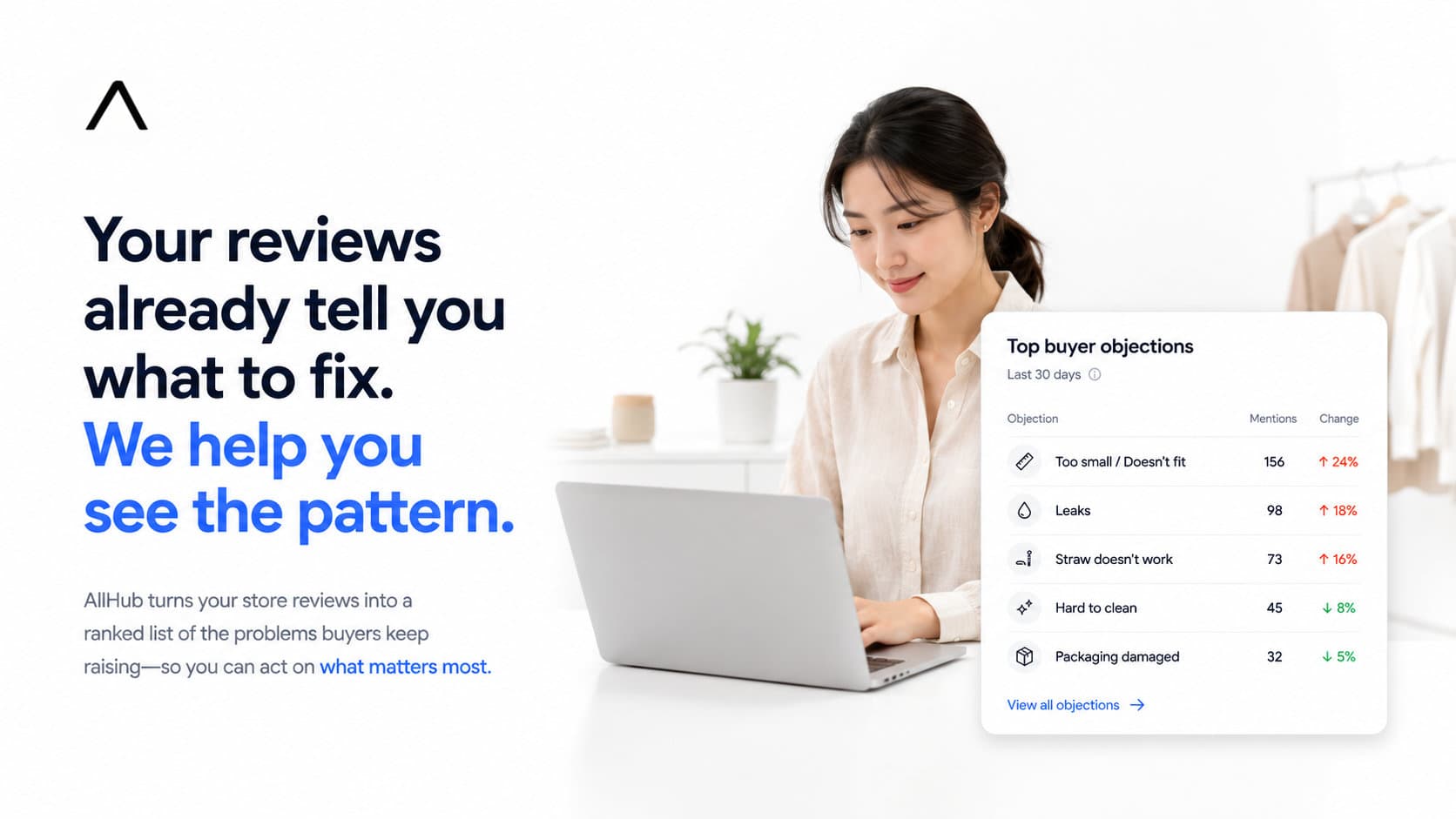
A review is a piece of evidence. The useful operating unit is the recurring objection behind several pieces of evidence. “Too small,” “doesn’t fit” and “the size chart is wrong” can become one named objection with one count. The original reviews must stay attached because grouping is an interpretation, not a replacement for what customers actually wrote.
This change in unit makes prioritisation possible: recurring product issues are what a store can schedule work against, while single reviews are not. The merchant can compare the share of complaint volume, see whether an objection increased against the previous 30 days and inspect its eight-week history. Frequency establishes that the issue deserves attention. Direction establishes whether it can wait. The source reviews establish whether the generated label describes the evidence fairly.
Example — two returns become a question worth checking
Evidence: a seller moved thirty bottles and received two returns saying the straw did not work.
Objection: “Straw fails to draw liquid.”
Next check: inspect returned units, instructions, assembly and batch information before deciding what caused the failure.
A useful product feedback analysis workflow has four steps, and skipping one creates a bad decision. First name the underlying objection without erasing the wording behind it. Then count how many separate buyers raised it. Next compare it with the previous period and its recent history. Finally point the investigation at the part of the store most likely to change the outcome.
That final step matters because the product is not always the cheapest or correct place to intervene. Buyers may call an item “smaller than expected” because the dimensions are buried. They may report “wrong colour” because the photography creates an expectation the product cannot meet. They may complain about assembly because the instruction image skips one motion. The reviews identify the gap; a person still verifies the cause and chooses the change.
The Reputation Agent connects to review sources the merchant already owns and has authorised. When the merchant runs a scan, it reads the available reviews, groups equivalent problems, ranks the objections and keeps every supporting review one click away. It does not ask the merchant to trust a score without evidence.
The agent also drafts a reply in the reviewer’s own language. That draft removes the blank page and the translation problem; it is not a finished public response. The merchant adds the order-specific facts, tone and accountability, then chooses whether to edit and post it. The Reputation Agent never posts to a review platform on the merchant’s behalf.
Example — the draft is the starting point, not the voice of the store
Review: “The bottle is good, but the straw stopped working after two days.”
Draft: “Thank you for explaining what happened with the straw. We are sorry the product did not work as expected and would like to investigate the affected item.”
Merchant edit: add the real support route, what can be checked and the specific next step the store will own before publishing.
Customer complaints analysis is only ever as good as the sources it may lawfully read, so that boundary should be understood before a merchant decides to use the product. Google Business Profile and Trustpilot are supported through official APIs with the merchant’s authorisation. WooCommerce and Wix product reviews can be read from the connected store. Amazon reviews and Shopify product reviews cannot. Competitors’ reviews are outside the product by design.
These limits are commercially relevant, not footnotes. A Shopify merchant can still use Google and Trustpilot today, but their on-site product reviews remain out of reach. An Amazon seller should distrust any promise of lawful review monitoring at scale when no official review API exists. “No scraping” means accepting a narrower product in exchange for a safer one.
An objection must appear in three separate reviews before it enters the ranking. One angry review never becomes a task. This protects the merchant from reorganising the store around the loudest isolated customer, but it also means a genuinely new problem remains invisible until the third mention. Stores with only a handful of reviews each month will see a thin picture. Five-star praise is not analysed for complaints, so a small gripe inside an otherwise glowing review can be missed.
The evidence must remain available long enough for a merchant to verify the objection, but the reviewer does not need to become a profile. Even when a connected platform sends a name, the Reputation Agent does not store it. Reviews appear as coming from a verified reviewer, and the text is deleted after 24 months. A ranked objection cannot outlive the source reviews that justified it.
Review text is also untrusted input written by a stranger. If somebody hides an instruction inside a review—asking the system to ignore its rules, reveal information or perform an unrelated action—the instruction is handled as text to analyse, not a command to follow. The agent reads authorised review sources for one narrow purpose: organise the merchant’s own evidence into problems worth checking.
From the AllHub dashboard, the merchant connects an authorised source and runs a scan on demand. The page shows ranked objections, their counts, share of complaint volume, movement against the previous 30 days and an eight-week history. There is no continuous monitoring and there are No notifications when a complaint begins to grow; the merchant sees the change when they run a scan and open the page.
The agent does not audit the listing or inspect the product. It can show that buyers repeatedly expected something different; it cannot identify which bullet point, photograph or production step caused that expectation. That decision belongs to the merchant, supported by the attached reviews and whatever product, support or supplier evidence they gather next.
AllHub is opening the pilot to stores that already receive enough reviews to reveal patterns and want a clearer order of work. You can see how the Reputation Agent works before connecting a source. The first ten stores on each platform receive three months free in exchange for a short weekly feedback call with the founders.
A review inbox is evidence without an order of work. A star average is sentiment without a diagnosis. The useful operating view sits between them: recurring objections, ranked by how many buyers raised them, compared over time and kept inseparable from the reviews that justify the count.
The Reputation Agent does not promise to read every review source, catch the first mention, alert the team automatically or publish a reply. It gives the merchant a disciplined place to begin: run a scan, identify what is repeated, inspect the evidence, verify where the fix belongs and make the public response human before it goes live.
The weekly question is not “Did our average rating move?” It is “What are buyers telling us repeatedly that we still have not fixed?” If that is the question your current review tools cannot answer, join the pilot on your platform—or see how it works first before you connect anything.
Written by AllHub Team · AI Agents for Ecommerce
We build the AI agent team that sells, supports and grows ecommerce stores — EU-hosted, GDPR-first.
This article was created with the help of AI and reviewed by our team. We take great care over every post and every translation, but the odd mistake can still slip through. If you find one, write to us: you will be helping us improve.
AI-generated contentWaiting may reduce technology risk, but it postpones the learning that can only happen with your catalogue, processes and customers.
 AI-generated content
Before connecting an AI agent, define the friction you want to remove, the signals that prove it exists and the evidence you will use to assess the result.
 AI-generated content
Every tool for Amazon sellers promises rankings, repricing or reviews. This does none of that. One connection to your seller account, a set of agents on top of it: one answers your buyers, the rest answer you.