Your Product Page Cannot Answer the Question That Is Blocking the Sale
AllHub Team··8 min read
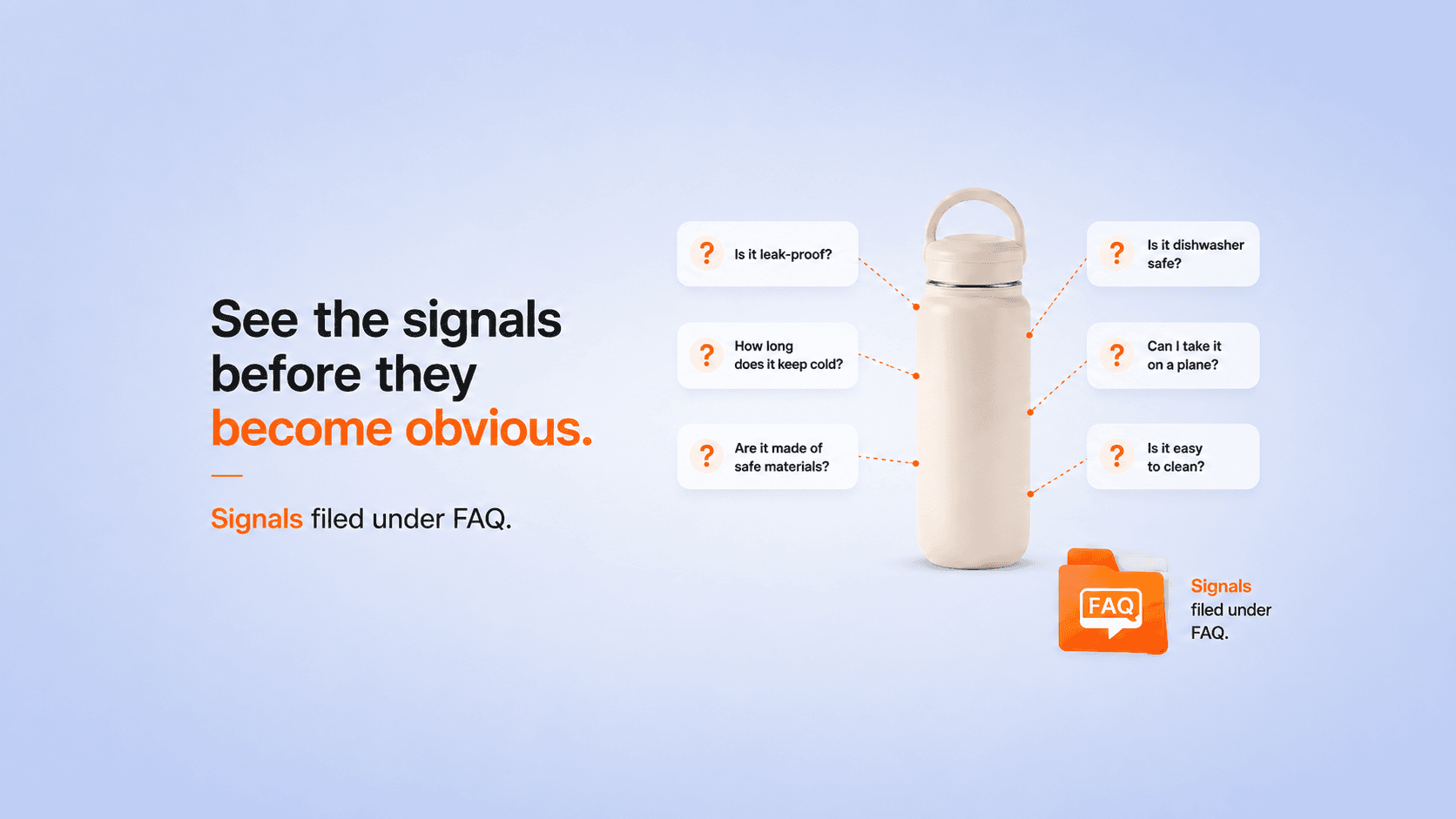
A buyer does not arrive at a product page as an empty audience waiting to be persuaded. They arrive with a fixed, practical list of doubts. Will it leak? How much does it hold? Will it fit in the fridge or the bag they already own? Is it food-safe? Can it be stacked? Is it awkward to clean? A title, price, gallery and generic description may look complete while answering almost none of those questions. When the buyer leaves, the seller records another session with no order—but never learns which of those unanswered product questions blocked the sale.
That silence creates a misleading diagnosis. The merchant sees a product-page exit and starts changing photographs, buttons, discounts or page speed. Those may be valid tests, but they do not answer a doubt about dimensions, materials, care or compatibility. If the information required for the decision is absent, improving the presentation of the same incomplete page only makes the gap look more polished.
AI-generated content
A static page can show the product and still miss the question that determines whether the buyer continues.
A static page is built around prediction. The seller decides which facts matter, writes them into fixed fields and publishes one version for everybody. The buyer approaches from the opposite direction: a specific use case produces a specific question. A parent wants to know whether the lid survives a school bag. A renter wants to know whether the container fits one narrow shelf. A customer replacing another product wants to compare an exact dimension. The page can only answer when the seller predicted both the question and the language used to ask it.
This is why a long description is not automatically a useful one. More copy can repeat benefits without resolving uncertainty. “Premium, versatile and made for everyday life” occupies space while saying nothing about leak resistance, internal capacity or dishwasher limits. A useful product page FAQ begins with decisions the buyer must make, then supplies facts that can support those decisions.
Identify the use-case question. “Will it fit?” is incomplete until the store knows where, alongside what and in which orientation.
Answer with a verifiable attribute. Dimensions, materials, capacity, care instructions and policy conditions are stronger than another adjective.
Place the answer where doubt appears. Do not make a buyer search a generic help centre for a product-specific fact.
Record the missing question. A repeated unanswered doubt should improve the catalogue, not disappear with the session.
What a Buyer’s Fixed List of Doubts Actually Hides
The six questions in the source signal are not proof that every market shares one universal FAQ. They are useful because they show the different kinds of confidence a buyer may need before paying. Treating them as categories is more durable than copying six questions onto every product page.
Performance confidence. Will it leak, insulate, support weight, connect reliably or do the job described?
Spatial confidence. Does it fit the fridge, cupboard, bag, room, device or existing setup?
Safety confidence. Are the materials and intended uses stated clearly enough for this customer’s context?
Ownership confidence. Is it easy to clean, maintain, store, stack, repair or return?
A seller may have the answer somewhere—in a supplier sheet, support reply, return policy or employee’s memory—without having it in the product record. From the buyer’s perspective, information that cannot be found at the decision point does not exist. From an AI system’s perspective, information that is not structured, approved and retrievable cannot safely become an answer.
Turn Repeated Buyer Doubts Into Better Product Information
The first goal is not to automate a clever reply. It is to turn a question into a catalogue improvement. When shoppers repeatedly ask whether a bottle leaks, the store needs a grounded performance statement and the evidence behind it. When they ask whether it fits a refrigerator door, the record needs accurate external dimensions and perhaps an orientation note. When they ask whether it is food-safe, the answer needs approved material and compliance information—not language guessed by a model.
This creates a practical loop: capture the wording, group equivalent doubts, find the authoritative source, add or correct the attribute, publish the answer and monitor whether the same uncertainty returns. The conversation becomes editorial research. The catalogue becomes more complete for the next buyer, whether that buyer uses chat, search, a marketplace, an AI recommendation service or the ordinary product page.
Example — from a vague exit to a catalogue correction
Buyer: “Will the large container fit upright in a 30 cm refrigerator shelf?”
Store: “The external height is 28.4 cm with the lid fitted.”
Catalogue action: add external height, lid state and measurement method to the approved product record.
Improve the product record
The immediate answer helps one buyer. The structured correction helps every channel that uses the catalogue.
What Conversational Commerce Honestly Cannot Fix
Conversation does not repair unreliable source data. If a catalogue says 750 ml in one field and 900 ml in another, an assistant cannot make both true. If the return policy is ambiguous, the model should not choose the interpretation that sounds most helpful. If a safety claim has not been approved, fluency is not evidence. AI can make information easier to request; it cannot manufacture trustworthy facts.
It also cannot prove why every silent visitor left. A shopper who asks about cleaning gives the merchant a real signal. A shopper who leaves without asking gives none. Patterns in expressed questions can guide research and content priorities, but they should not be projected onto every exit. The two FAQ signals behind this article came from one Reddit room and were already answered thread by thread. They are qualitative evidence of a problem worth examining, not a market prevalence estimate.
The honest promise is smaller and more useful: give a buyer somewhere to ask, answer only from approved information, say when the answer is missing and turn repeated gaps into work for the merchant. That reduces avoidable silence without pretending to read minds.
Questions a Product Page Should Be Ready to Answer
The best question set depends on the product, audience and intended use. These prompts are a starting map, not a universal template:
“What are the external and internal dimensions, and how were they measured?”
“Will it work with the model, space or accessory I already have?”
“Which materials touch food, skin or heat, and what claims are approved?”
“Can it be stacked or stored in the orientation I need?”
“Which parts can go in the dishwasher, washing machine or normal cleaning routine?”
“What happens if I open, assemble or test it and then need to return it?”
A useful answer is specific, sourced and conditional where necessary. It distinguishes product fact from recommendation. It can say “the external width is 18 cm” without claiming “it will fit your cupboard” until the buyer supplies the available width. It can quote an approved care instruction without extending it to a cleaning method the manufacturer never evaluated.
Prepare a Machine-Readable Catalogue Before Asking AI to Sell From It
Your product catalogue, descriptions and return policies need to be a machine-readable catalogue, not merely pages that look understandable to a person. The record should separate dimensions, units, materials, variants, compatibility, care, certifications, delivery conditions and return rules into stable fields with clear ownership. Otherwise retrieval depends on fragments of marketing prose and conflicting documents.
Example — a defensible product answer
Approved attribute: external dimensions 28.4 × 18 × 9 cm, lid fitted.
Approved care: container dishwasher-safe on top rack; lid hand-wash only.
Missing evidence: no approved leak-proof claim for horizontal transport.
Answer with the available evidence
A trustworthy assistant gives two supported answers and names the limit instead of turning “water-resistant” into “leak-proof”.
The same discipline benefits more than chat. Structured facts improve onsite search, comparison tables, marketplace feeds, accessibility, support consistency and the ability of external AI systems to understand the offer. If the underlying catalogue and policies are unreliable, AI only accelerates disappointment: it distributes the inconsistency faster and with greater confidence.
How It Works on Your Store
AllHub connects a conversational storefront with Store Brain. The conversational storefront lets buyers ask product and policy questions in ordinary language while they are deciding. Store Brain helps the merchant examine recurring themes and identify the catalogue or policy gaps that deserve correction.
Connects to Shopify, WooCommerce, Wix or Amazon without rebuilding the storefront.
Answers from connected, merchant-approved product and policy information.
Says when an attribute or rule is missing instead of inventing a convenient answer.
Surfaces recurring question themes so the merchant can improve the source record.
Returns buyers to the merchant’s own store to complete checkout under its terms.
Stores data in the EU and filters personal data before it reaches an AI model; GDPR Article 17 erasure remains available.
This does not replace product expertise, catalogue governance, customer research or legal review of claims and policies. It creates a usable path between them. Buyers get a grounded answer at the moment of doubt; merchants get a clearer queue of information that must be added, corrected or approved.
Early Access: What It Is, and What It Costs You
AllHub is in soft launch. The first ten stores on each platform get three months free. The price is not money—it is ten minutes on a call, once a week.
We are looking for merchants whose buyers ask practical product questions and whose catalogue contains the real-world complexity those questions expose. You show us where an answer helps, where the source record is incomplete and where the system should refuse to guess. We set it up with you and turn that feedback into a better product.
We review your store and platform fit within 24 to 48 hours.
A 30-minute onboarding call at a time that suits you.
Your agents go live in under an hour.
Three months free for the first ten stores per platform.
A static product page answers the questions the seller remembered to publish. A buyer decides with the questions their own situation creates. The commercial gap sits between those two lists. When the page stays silent, the merchant sees an exit but loses the most useful part of the event: what the person still needed to know.
Do not begin with a more persuasive sentence. Begin with a more reliable product record and a place where the buyer can ask. Capture repeated doubts, answer from approved evidence and let missing answers become catalogue work. The goal is not endless chat. It is fewer avoidable decisions made in silence.
If buyers keep asking questions your product pages did not anticipate, the answer is not another generic FAQ. Build a catalogue that can support specific answers and give shoppers a way to request them. Join the pilot on your platform—ten stores per platform, three months free, and ten minutes of honest feedback each week.
We build the AI agent team that sells, supports and grows ecommerce stores — EU-hosted, GDPR-first.
This article was created with the help of AI and reviewed by our team. We take great care over every post and every translation, but the odd mistake can still slip through. If you find one, write to us: you will be helping us improve.
Yes. A comparison can use correct facts and still reach a harmful conclusion when it ignores audience, positioning or the reason behind each difference.

 AI-generated content