
 AI-generated content
·8 min read
Why shouldn’t you wait to adopt AI agents in your ecommerce store?
Waiting may reduce technology risk, but it postpones the learning that can only happen with your catalogue, processes and customers.
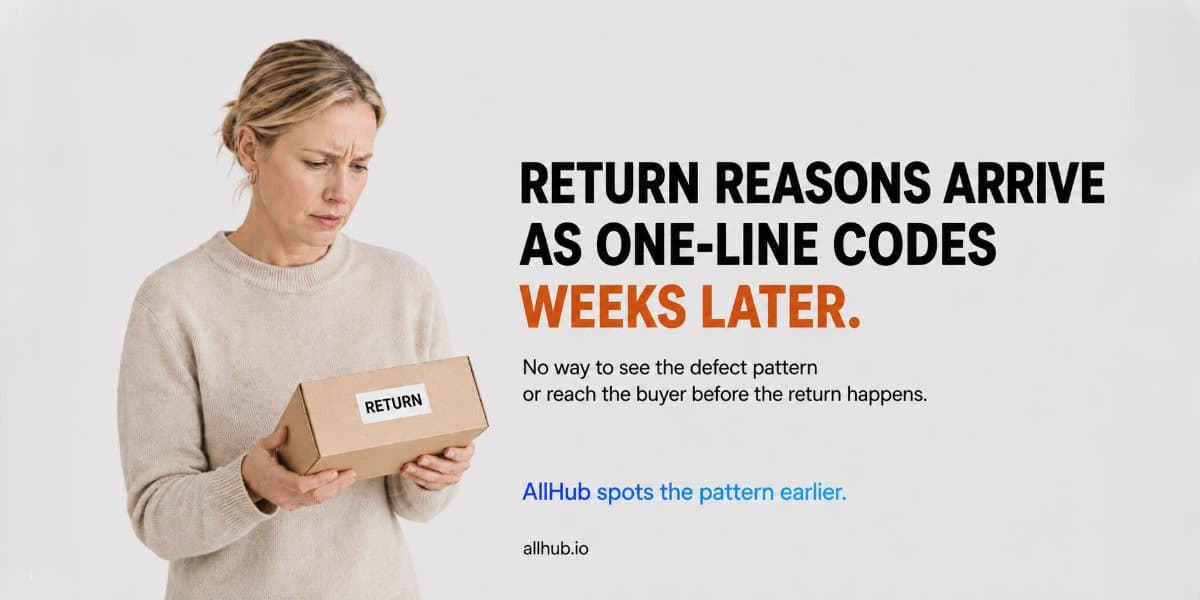
A return reason often arrives as a code: defective, not as described, changed mind, other. It may appear days or weeks after the buying decision, stripped of the conversation that would make it useful. The merchant sees an outcome but not the sequence behind it. Did a straw fail on first use? Did the buyer ask for help and receive no reply? Was one component missing, one instruction unclear or one promise misunderstood? By the time the code reaches the dashboard, the buyer has packed the item, requested the refund and mentally left the store. The signal is real, but the opportunity to act has already gone.
This is the hidden cost of late customer feedback. A return costs more than reverse logistics or lost margin. It also delays the merchant’s understanding. If several customers meet the same product defect while every incident is compressed into a generic label, the store cannot see the pattern early enough to correct the listing, inspect the stock, contact the supplier or warn the next buyer. The return system becomes an archive of finished failures instead of an early-warning system.
 AI-generated content
Return codes are designed for classification, not diagnosis. They help route a refund, group operational totals and satisfy a marketplace workflow. That is useful, but a label such as “defective” cannot tell the merchant which part failed, under which conditions, at what point in ownership or whether the customer tried to get help first. Thirty identical labels could describe thirty different faults. Two apparently different labels could describe the same broken component.
One source signal behind this article described two returns among thirty bottles sold in a month, with the same reported problem: the straw did not work. That observation matters because it names a component and a failure mode. It does not prove a universal defect rate, and a sample of two cannot establish whether the cause was manufacturing, assembly, instructions or use. It does create a concrete inspection question that the code “defective” would have hidden.
A merchant cannot recover time. When a useful detail appears only after a return closes, every unit sold during the delay carries the same unresolved risk. The listing still makes the same promise. Support still lacks the same answer. The warehouse still ships from stock nobody has inspected for that specific problem. Even when the financial value of one return is small, the information delay can spread the cost across later orders.
The second source signal shows a different failure. A customer left a necklace for re-plating, waited almost two months and eventually had to chase the business to get the original necklace back. This is not evidence of a product defect. It is evidence of a service journey in which ownership, status and communication became unclear after payment. Grouping both stories under “customer service” is useful for filing; treating them as the same operational problem would be a mistake.
The most valuable moment is often before the customer has decided to return. A buyer asking why the straw will not draw liquid is still trying to make the product work. A customer asking when a re-plating job will be ready is still asking the business to restore confidence. A grounded answer, a clear status or an honest escalation may help. Even when the return remains the correct outcome, the conversation preserves detail while the evidence is fresh.
This does not mean intercepting every shopper with an intrusive survey. It means making a relevant path available at the point of uncertainty: on the product page, in the order journey and wherever the merchant already promises support. The question should be easy to ask in ordinary language. The answer should come from approved product, policy and order information. When that information is missing, the system should say so and create work for a human rather than improvise.
Example — preserve the failure mode before the return
Buyer: “The straw is fitted, but no liquid comes through. Is there a seal I need to remove?”
Store: “I cannot verify that from the approved instructions. I can record the exact issue and route it for product support.”
Merchant action: link the question to the product, variant and order; inspect instructions and stock before making a broader claim.
Individual conversations become operationally valuable only when equivalent issues can be grouped without erasing their differences. “Straw blocked,” “cannot drink through lid” and “suction does not work” may belong to one review cluster. “Where is my repair?” belongs somewhere else. The merchant needs a queue that keeps the original wording and source while adding a cautious theme, product association, timing and resolution state.
The right workflow moves from signal to verification. First capture the question. Then check whether the answer already exists in approved information. If not, assign an owner to inspect the product, documentation, fulfilment or service process. Only after verification should the store update a listing, publish guidance, contact affected customers or raise a supplier issue. Frequency helps prioritise; it does not turn an unverified explanation into fact.
The research input for this article contains two signals filed under customer service, read in one Reddit room and already answered one thread at a time. They show that merchants and buyers describe useful operational detail in public discussions: a named component that failed and a service relationship that went silent. They support the decision to investigate how stores capture and route such detail earlier.
They do not tell us how common either problem is, whether the bottle issue affected one batch, whether the necklace business had attempted contact elsewhere or whether a conversation would have prevented either outcome. They cannot support a universal return-rate claim or a promise that chat reduces returns by a specific percentage. That boundary matters. A system built to improve evidence should not begin by overstating the evidence that justifies it.
Example — signal, hypothesis and verification
Signal: two buyers reported that the straw did not work.
Hypothesis: one component, instruction or batch may need inspection.
Verification: review the returned units, approved instructions, variant data and any additional related contacts.
A practical issue record should preserve the customer’s wording, affected item or service, order stage, date, channel, attempted resolution and evidence status. It should distinguish what the customer observed from what the merchant verified. Personal data should be minimised, access-controlled and retained only as long as the legitimate purpose requires. The goal is not to build a permanent dossier on a buyer. It is to give the responsible team enough context to correct a product or process.
AllHub connects a conversational storefront with Store Brain. The storefront gives shoppers somewhere to ask product, policy and order questions while they can still act on the answer. Store Brain helps the merchant examine recurring themes across the information the store has legitimately connected, while keeping observed evidence separate from an AI-generated interpretation.
A conversational storefront cannot inspect a returned unit, determine legal liability or prove that two complaints share one cause. It can shorten the distance between a buyer’s uncertainty and the merchant’s awareness. That is enough to change the operating question from “How many defective returns did we log last month?” to “Which unresolved issue should we verify today?”
AllHub is in soft launch. The first ten stores on each platform get three months free. The price is not money—it is ten minutes on a call, once a week. We are looking for merchants willing to show us where real buyer questions expose missing product information, unclear service ownership or a pattern worth investigating.
You do not need a perfect support operation or a large dataset. You need a real store, real customer questions and the willingness to separate what happened from what you think caused it. We set up the connection with you, learn where the agent helps or fails and use that feedback to improve the product.
A one-line return reason is not useless. It is simply too compressed and too late to carry the whole lesson. The merchant needs the words that came before it: what failed, when it failed, what the buyer expected and whether anybody had a chance to help. Without that context, a defect pattern can remain invisible while the next unit leaves the warehouse.
Do not replace cautious investigation with automated certainty. Give the buyer a way to ask, preserve the specific signal, group it without erasing its source and verify the cause before changing the product story. Some returns will remain necessary. The win is learning early enough that the next buyer does not have to discover the same unresolved problem alone.
If useful product and service feedback reaches you only after the return closes, tell us whether you are seeing this too. Join the pilot on your platform and help us build a shorter path from buyer question to merchant action—before another one-line code arrives weeks later.
Written by AllHub Team · AI Agents for Ecommerce
We build the AI agent team that sells, supports and grows ecommerce stores — EU-hosted, GDPR-first.
This article was created with the help of AI and reviewed by our team. We take great care over every post and every translation, but the odd mistake can still slip through. If you find one, write to us: you will be helping us improve.
AI-generated contentWaiting may reduce technology risk, but it postpones the learning that can only happen with your catalogue, processes and customers.
 AI-generated content
Before connecting an AI agent, define the friction you want to remove, the signals that prove it exists and the evidence you will use to assess the result.
 AI-generated content
Every tool for Amazon sellers promises rankings, repricing or reviews. This does none of that. One connection to your seller account, a set of agents on top of it: one answers your buyers, the rest answer you.