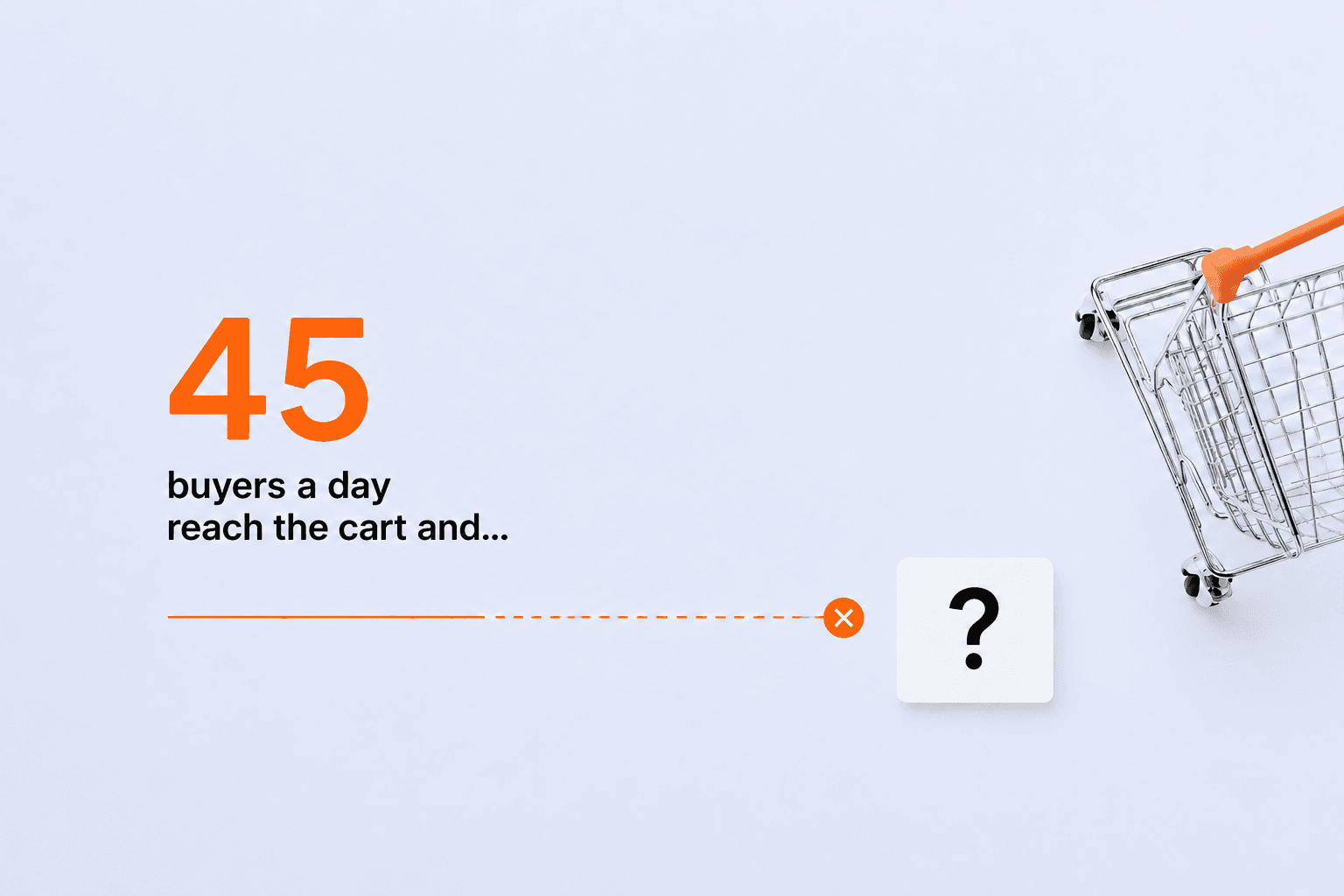
Forty-Five Buyers Reach the Cart Every Day. The Store Never Asks What Stopped Them.
AllHub Team··8 min read
Forty-five buyers reach the cart on an average day. They have already found a product, considered the price and moved further than most visitors ever will. Then they leave. The store sees a 91% cart abandonment rate in this particular case, but the number ends where the useful question begins. Did delivery take too long? Was the return policy unclear? Did the buyer need to confirm compatibility, sizing, materials or what came in the box? The dashboard records an exit. It does not record the answer the buyer could not find.
That distinction matters because the usual response is to change checkout. Remove a field. Change the button. Add a discount. Send another recovery email. Any of those may help when the checkout itself is the problem. None answers an unanswered pre-purchase question. If the shopper reached the cart still unsure whether the product would arrive in time or work for their use case, the sale was already fragile before the payment form appeared.
AI-generated content
The funnel shows where 45 buyers left. It does not show which question remained open when they did.
How to Understand Cart Abandonment Before Changing Checkout
To understand cart abandonment, separate the event you can measure from the reason you are trying to infer. “Added to cart but did not buy” is an event. “Shipping was too expensive” is a possible reason. So are “I could not tell whether it fits”, “I need it by Friday”, “I do not trust the returns process” and “I was only saving it for later”. A conversion report can establish the first statement. It cannot establish the others without more evidence.
A useful investigation connects the exit with the information surrounding it. Which products were in abandoned carts? Which questions appear repeatedly in support inboxes and product reviews? Where do shoppers open delivery or returns information? Do exits cluster by device, destination, product, variant or campaign? The aim is not to invent one tidy explanation. It is to narrow a broad metric into a small set of objections the store can actually examine.
Start with the affected carts. Product, variant, basket value, destination and journey stage are more useful than one blended abandonment percentage.
Look for repeated questions. Search support conversations, reviews and on-site behaviour for doubts buyers express in their own words.
Separate evidence from inference. “Buyers opened the delivery page” is evidence. “Delivery caused every exit” is not.
Test the smallest answer first. Put a clear, grounded answer where the doubt appears before rebuilding checkout or funding another discount.
What Forty-Five Abandoned Carts Actually Hide
The number looks like one problem because every journey ends in the same state: no order. Commercially, however, it can hide three different losses.
A checkout problem. The buyer wants the product but encounters an unexpected cost, broken field, missing payment method or confusing delivery step.
A product-confidence problem. The mechanics work, but the buyer still cannot confirm fit, compatibility, quality, care, contents or suitability.
A timing problem. The buyer is not ready today, is comparing alternatives or is using the cart as a temporary list. Nothing is necessarily broken.
Treating all three as checkout friction creates expensive noise. A shorter form cannot resolve a compatibility doubt. A discount cannot guarantee delivery before an event. A recovery email cannot help if it repeats the same product description the shopper already read. Before choosing a remedy, the store needs to know which kind of uncertainty it is dealing with—or admit that the evidence is not yet sufficient.
Turn an Unexplained Exit Into a Question the Store Can Answer
Most ecommerce analytics are organised around steps: product view, add to cart, checkout and purchase. Buyers are organised around questions. “Will it arrive in time?” can begin on the product page, continue in the cart and end the journey at checkout. The funnel sees three page views and an exit. The buyer experiences one unresolved doubt.
A conversational storefront gives that doubt somewhere to surface before checkout. The shopper can ask about a product, delivery condition, return rule or comparison in ordinary language. The answer stays grounded in catalogue and approved store information. That does not explain every historical abandonment, but it prevents some future journeys from remaining silent and gives the merchant a clearer view of the questions buyers actually ask.
Example — the question hidden behind the cart
Shopper: I need this for a birthday on Friday. Will it arrive in Madrid in time?
Assistant: Standard delivery to Madrid is listed as 3–5 working days, so Friday is not guaranteed. Express delivery is available at checkout with a 1–2 working day estimate.
Shopper: If it arrives late, can I return it unopened?
Assistant: Yes. Your returns policy allows unopened items to be returned within 30 days. I can show you the exact conditions before you continue.
Review delivery and returns
The assistant answers from approved delivery and returns information. It does not promise an arrival the store cannot guarantee.
Without that exchange, the store might record another abandoned cart and assume price sensitivity. With it, the shopper receives a usable answer and the merchant learns that delivery certainty and the return window matter at this decision point. The conversation does not prove why every other buyer left. It creates evidence where there was previously only silence.
What Cart Abandonment Data Honestly Cannot Tell You
Cart data cannot read intent. A shopper may leave because a meeting starts, because they want to compare on another device, because payday is next week or because they never planned to purchase. Two identical event sequences can come from entirely different decisions. Any system claiming it can assign a precise motive to every abandoned cart from clickstream data alone is overstating what the evidence supports.
An AI agent does not remove that limitation. It can organise connected data, find recurring patterns and connect a conversion change with products, traffic sources, operational events and expressed customer questions. It can suggest what to investigate next. It should not turn correlation into a confession from a buyer who said nothing.
The honest goal is narrower: reduce the number of decisions made in the dark. Ask for evidence, expose uncertainty and test one explanation against observable behaviour. Sometimes the result will be “checkout is broken”. Sometimes it will be “buyers need a clearer answer”. Sometimes there will not yet be enough information to say.
What Buyers Can Ask Before They Become Another Abandonment
The most valuable question is often ordinary, specific and absent from the analytics dashboard. A conversational layer lets it remain specific:
“Will this arrive before Friday at my postcode?”
“Does this include the adapter shown in the photograph?”
“Can I return it after opening the box?”
“Is this compatible with the model I already own?”
“Why is delivery more expensive for this item?”
“What is the difference between these two versions?”
The assistant answers only from information the merchant has approved and connected. Where the policy or product data supports an answer, it gives one. Where the answer depends on live inventory, destination or a condition not present in the data, it says what is missing. The point is not to force a conversation into every checkout. It is to stop making silence the only option when a buyer needs one answer to continue.
Prepare the Evidence, or Store Brain Can Only Show You the Same Funnel
Store Brain becomes useful when it can connect commercial outcomes with real store context: orders, carts, products, variants, traffic, support themes, stock changes, delivery performance and returns. A headline abandonment rate without that context is a warning light, not a diagnosis.
Example — a defensible investigation
Abandonment increased mainly on three bulky products, not across the whole catalogue.
Those products show a destination-based delivery surcharge in the cart.
Support conversations repeatedly ask why delivery costs more for those items.
Investigate the affected products
Three aligned signals support a testable hypothesis. They still do not prove that every shopper left for the same reason.
Useful inputs include product and variant identity, basket composition, checkout stage, device, traffic source, destination region, delivery options, operational incidents and pseudonymised themes from approved customer conversations. The merchant remains responsible for data quality, lawful collection and deciding which hypothesis is worth testing. Better analysis begins with better evidence, not a more confident sentence.
How It Works on Your Store
AllHub connects a conversational storefront with Store Brain. One helps buyers ask product and policy questions while they are deciding. The other helps the merchant examine store performance in plain English and trace a broad symptom back to the products, journey stages and operational context connected to it.
Connects to Shopify, WooCommerce, Wix or Amazon without rebuilding the storefront.
Lets buyers ask grounded product, delivery, returns and comparison questions before they leave.
Helps merchants investigate abandonment by product, journey stage and available store context instead of relying on one blended percentage.
Keeps evidence and inference separate, including when there is not enough data for a confident diagnosis.
Returns shoppers to the merchant’s own store to complete the purchase under the merchant’s checkout, policies and terms.
Stores data in the EU, with a privacy filter blocking personal data before it reaches any AI model. Full erasure is available on request under GDPR Article 17.
This does not replace reliable analytics, checkout testing, accurate product information or direct customer research. It joins the parts that normally sit apart: the question a buyer needs answered and the commercial pattern the merchant is trying to understand. When those two surfaces share grounded store knowledge, an unexplained exit can become a specific investigation instead of another generic optimisation project.
Early Access: What It Is, and What It Costs You
AllHub is in soft launch. The first ten stores on each platform get three months free. The price is not money—it is ten minutes on a call, once a week.
We are looking for merchants with real abandonment patterns and real buyer questions, run by someone willing to show us where the diagnosis helps, where the available evidence is incomplete and where an agent reaches the wrong conclusion. What you get back is the founders’ direct attention and setup done with you rather than handed to you.
We review your store and platform fit within 24 to 48 hours.
A 30-minute onboarding call at a time that suits you.
Your agents go live in under an hour.
Three months free for the first ten stores per platform.
Forty-five buyers leaving the cart is not forty-five explanations. It is one visible symptom produced by many possible decisions. The store can keep treating that symptom with generic recovery emails, discounts and checkout changes, or it can begin by asking what evidence would distinguish friction from uncertainty, timing and ordinary comparison behaviour.
The important shift is from “How do we reduce this percentage?” to “What did this buyer still need to know?” Not every abandoned cart contains an answerable question. But when it does, the best time to answer is while the buyer is still there—not two days later in a recovery sequence.
Do not make another blind checkout change just because the funnel ends in silence. Give buyers somewhere to ask and give your team somewhere to investigate. If your store has an abandonment pattern nobody can explain, request early access—ten stores per platform, three months free, ten minutes of honesty a week.
We build the AI agent team that sells, supports and grows ecommerce stores — EU-hosted, GDPR-first.
This article was created with the help of AI and reviewed by our team. We take great care over every post and every translation, but the odd mistake can still slip through. If you find one, write to us: you will be helping us improve.
Yes. A comparison can use correct facts and still reach a harmful conclusion when it ignores audience, positioning or the reason behind each difference.

 AI-generated content