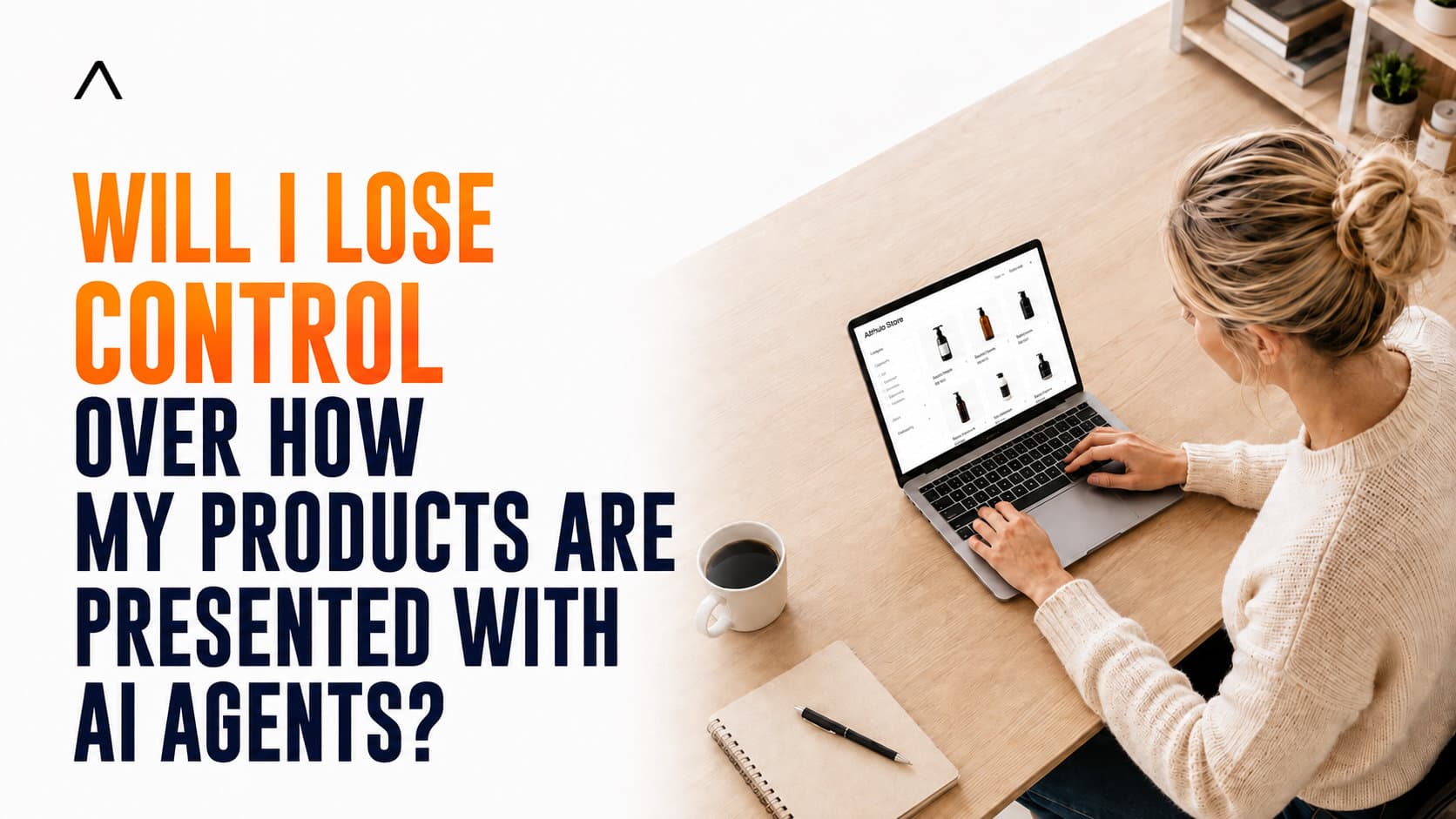
Will AI agents make me lose control over how my products are presented?
AllHub Team··6 min read
Your catalogue should not stop being your catalogue because you add a conversation. Images, names, variants, prices, availability and terms still belong to the store that publishes them.
The reasonable concern is not that an agent talks to a buyer. It is that it might mix external sources, feature products you do not sell or present an unapproved attribute as fact.
Real control starts with an architecture in which the connected catalogue, merchant rules and store checkout remain authoritative. This is product control with AI agents.
AI-generated content
The agent may explain and compare products, but catalogue, images, prices and commercial rules remain under store control.
What does retaining control over your products actually mean?
Control does not mean writing every answer yourself. It means deciding which products exist for the agent, which information it may use, which claims are allowed and where its authority ends.
What should be the only commercial source of truth?
Conversational Storefront Agent. The connected catalogue of your tenant is that source. It will use exclusively the products in your store’s connected catalogue: it will not show an external product, fill gaps from the internet or replace a missing item with an invented one.
Which elements remain under the store’s control?
Title, images, description, variants, price, currency, stock, materials, compatibility, delivery and returns come from connected sources. The agent selects and explains; it does not rewrite what the buyer will see on the product page.
The catalogue supplies truth, rules set boundaries, the agent explains and the store retains the transaction.
Can the agent recommend something you do not sell?
It should not. A useful recommendation connects a need with real products belonging to that tenant. The agent’s commercial universe begins and ends with the authorised catalogue.
What happens when your catalogue has no compatible option?
It must say so. It may explain which condition prevents a match, ask whether the buyer wants to relax it or return them to navigation. It cannot import an external solution to avoid acknowledging the limit.
How are products kept separate between stores?
Catalogue, knowledge, rules and credentials remain isolated by tenant. If an item cannot be traced to the conversation’s storeId, it is not eligible to appear.
Does explaining a product better mean changing how you present it?
No. The agent may reorganise approved information around a need: highlight that a backpack fits under a seat or that a chair fits the available space. It changes the order of context, not the facts.
What can the agent do without invading commercial decisions?
It may filter, compare attributes, explain differences, show documented limits and link the correct product page. The store defines the facts and the agent makes them understandable. That is control how AI agents present products.
What must it never change on its own initiative?
It does not change images, titles, price, stock, discounts, materials, claims, warranties or policies. Nor does it permanently publish, delete or reorder products. A conversation grants no administration permission.
The agent explains and compares approved data; it does not modify catalogue or operations.
Who decides the tone and presentation of each product?
The store does. You define tone, vocabulary, prohibited claims, priority categories, excluded products and situations in which uncertainty must be acknowledged. The agent may adapt the explanation without changing its meaning.
How does brand identity become concrete rules?
Use observable limits: no unproven superlatives, no sustainability claim without evidence, no size recommendation without a connected chart and no turning a preference into a guarantee. “Sound premium” protects nothing by itself.
Can you exclude or prioritise products without misleading buyers?
Yes. You may remove discontinued or restricted items and set commercial priorities. But a promoted product that violates a constraint must never displace a compatible one.
How can you know where every displayed fact came from?
The answer must connect product, variant and attributes to the connected source. Sounding correct is not enough: price and availability must be verifiable against the store’s current state.
What should the owner be able to review after a conversation?
The need detected, criteria applied, products retrieved, source supporting each claim and product page selected by the buyer. This lets you correct a rule without auditing a black box.
What happens when price or stock changes?
The product page and checkout keep the final word. The agent must consult recent data, avoid promising unverified availability and direct the buyer to the merchant’s transactional surface.
Product, variant, price and explanation retain verifiable provenance inside the tenant.
Does Store Brain control your catalogue or help you understand it?
Store Brain Agent. It gathers connected knowledge, identifies gaps and lets you inspect questions that cannot be answered. It does not become the owner of the catalogue.
What is the difference between adding knowledge and adding products?
A policy or size guide helps explain an existing product; it does not create a sellable item. Documents complement conditions, but only the catalogue determines which products can be shown.
Can it learn from questions without automatically changing the store?
Yes. It can flag repeated questions about compatibility or measurements. The signal goes to the owner for a decision; detecting a gap does not authorise editing a page or publishing a claim.
Who retains control when the buyer decides to proceed?
Your ecommerce store does. The agent may prepare a selection or cart with real variants, but final price, identity, payment, order, invoice and terms remain in the merchant infrastructure.
Does adding to cart allow the product to be modified?
No. The cart references an existing variant and quantity. If it does not exist, is out of stock or changed price, the store resolves that before confirmation. The agent does not create a variant to complete the intent.
Can it confirm payment or an order on the store’s behalf?
No. AllHub does not touch money or become the seller. The store presents the total, processes payment and confirms the order. Conversation helps the buyer arrive; it does not replace the sale.
How can you test AI agents without surrendering control of your products?
Start with one category, read-only permissions, explicit sources and excluded products. The pilot must prove that the agent stays inside its boundaries and stops when information is missing.
What should a minimum reversible test include?
One identified category and tenant.
The real catalogue as the exclusive source.
Brand, claim and exclusion rules.
Cases with a match, no option and missing data.
Source and error logging.
A switch-off that restores the previous journey.
What evidence proves that you remain in control?
You can explain why each product appeared, exclude it, correct its source, review a claim and switch off the agent without altering catalogue or checkout. That is AI agents and catalogue control.
Expand, adjust or stop the test without modifying the main store.
You do not lose control by adding agents. You would lose it by accepting mixed catalogues, hidden sources, invented attributes, administration permissions or actions outside checkout. That design decision must not be delegated.
Before connecting an agent, ask where products come from, how tenants are isolated, which permissions it requests, how it handles missing data, what it may change, where the purchase ends, what it logs and how it is switched off.
The right decision is to keep catalogue, brand and operations authoritative; let the agent explain only what it can substantiate; and measure whether it helps the buyer. Do not expand a pilot that fails those limits.
Your products do not become the property of AI. The agent finds, compares and explains items you already sell. Your store decides what exists, what is true, how it is presented and where the purchase is completed.
We build the AI agent team that sells, supports and grows ecommerce stores — EU-hosted, GDPR-first.
This article was created with the help of AI and reviewed by our team. We take great care over every post and every translation, but the odd mistake can still slip through. If you find one, write to us: you will be helping us improve.
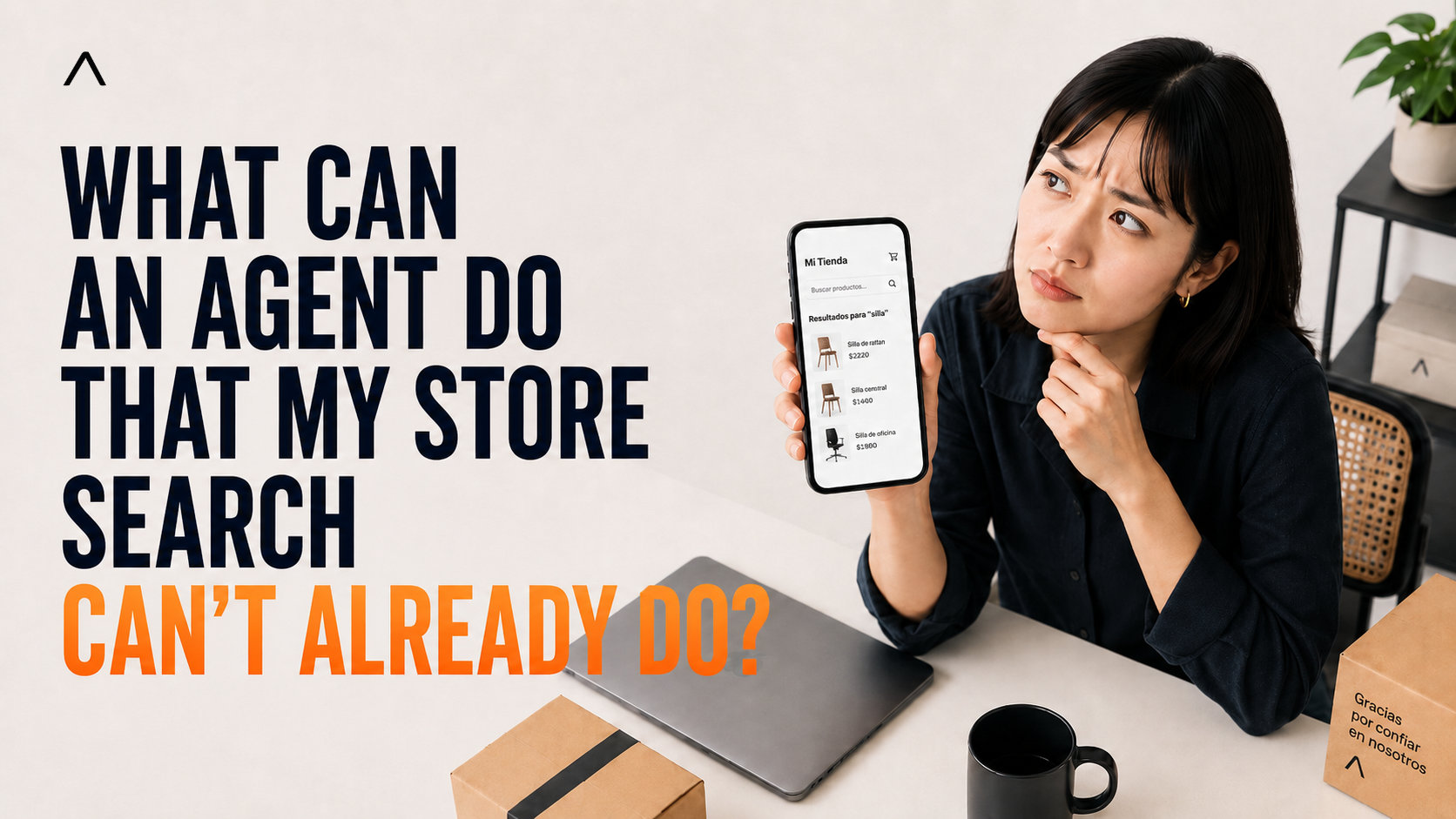
Search finds products when a shopper knows what to type. An agent helps when they know the outcome they need but cannot yet turn it into a useful query.
Before connecting an AI agent, define the friction you want to remove, the signals that prove it exists and the evidence you will use to assess the result.

 AI-generated content